Does Mold Fogging Work? A Florida Mold Assessor Explains
Before You Agree to a Fog Treatment, Read This.
The following reflects the professional observations of Julián Falgóns, licensed mold assessor and founder of Clean Air Miami, based on over ten years of field experience in Florida.
If someone has already quoted you a mold remediation fog treatment, this is exactly the right moment to consider the following. You found mold, someone promised they could fix it without tearing out a single wall. No demolition, no disruption, a 1-day mold remediation guarantee, and a clearance certificate at the end. The cost and time savings sound a lot better than a traditional, full remediation. That is completely understandable.
In ten years of mold assessments across Florida homes, condos, and commercial properties, I have started seeing this scenario with increasing frequency: a fog treatment performed, a clearance certificate issued, and mold, sometimes still actively growing, still present. It is now occurring frequently enough that property owners need to understand what is going on before they make this decision.
This article is my professional opinion on why demolition-free fogging might fail, what the industry standards actually say, and what you need to know before making a choice that could affect the health of everyone living or working in that space and actually prolong the necessary mold remediation.
What Are Mold Fogging Treatments and How Do They Work?
Fog-based mold treatments are marketed under a wide range of names and claims. If you have been researching your mold remediation options, some of these may sound familiar:
- Cold fogging or cold mist application
- Ultra-low volume (ULV) cold fogging or ULV foggers
- Thermal fog or hot fog
- Dry fog or patented dry fog technology
- Aerosolized antimicrobial treatment
- Fog mold remediation
- No-demo mold removal
- 1-day mold remediation
You may have also seen guarantees marketed as "mold gone, guaranteed" or similar language promising complete mold eradication in a single visit.
These are all variations of the same general approach: equipment that combines compressed air and a liquid treatment agent to produce a fine mist or vapor that fills the affected space. Depending on the system, the fogging chemical used may be a hydrogen peroxide-based solution, peracetic acid (PAA), quaternary ammonium compounds (commonly known as quats), chlorine-based compounds, chlorine dioxide, or another aerosolized antimicrobial compound. The specific chemical used varies by company and system and is not always disclosed upfront.
Beyond the chemical itself, the delivery methods vary as well. Certain systems add an electrostatic element to the mist to improve surface adhesion, while others follow the fogging treatment with the application of an antimicrobial film promoted as a barrier to prevent mold from returning.
The premise behind these treatments is that the fogging chemical can penetrate walls, denature mold and other microbes in the air and on surfaces, eradicate mold by chemically eroding the cell wall through a process called lysis, and denature the protein within, rendering it inert. All of this, according to the pitch, without physically removing any building materials.
That premise might be where the problem begins.
Fogging Is Not Mold Remediation
Let me be direct about something before going further: fogging alone is generally not mold remediation. It may be a supplemental tool in specific scenarios or as an add-on treatment. But as a standalone treatment for active mold contamination in an occupied space, it usually does not meet the professional standard.
The ANSI/IICRC S520 Standard for Professional Mold Remediation, developed in collaboration with microbiologists, public health professionals, and industrial hygienists, is unambiguous: the fundamental principle of mold remediation is source removal. The IICRC further recognizes that vapor-based antimicrobials have significant limitations as remediation tools and that fungal growth should be physically removed rather than simply treated with a chemical agent. Killing mold does not constitute proper remediation. Mold growth must be physically removed because killing it may leave behind spores that continue to cause allergic and toxigenic responses in occupants.
This is not a fringe position. It is the professional standard that licensed, trained, and insured remediation contractors are expected to follow.
Can Mold Actually Be Removed Without Demolition?
In many cases, no.
If mold is growing on or inside wet, damaged, porous building materials including drywall, wallpaper, insulation, wood framing, or similar absorbent materials, those materials typically need to be physically removed and eventually replaced. No fogging chemical, regardless of how it is marketed, reverses water damage or eliminates mold that is embedded in compromised materials.
There is an additional concern that rarely gets mentioned in the sales pitch: the fogging chemicals themselves. Peracetic acid, hydrogen peroxide-based compounds, and other aerosolized antimicrobials used in these treatments can cause VOCs to off-gas into the indoor environment. For chemically sensitive individuals, people with asthma, respiratory conditions, or multiple chemical sensitivity, this introduces a separate health risk on top of the mold problem being treated. A treatment that introduces new chemical exposure to vulnerable occupants while failing to resolve the underlying contamination is not a solution. In some cases it creates an additional problem where only one existed before.
What the Testing Results Revealed Every Single Time
In every case I have personally observed where fogging was used as the primary remediation method on active mold contamination, our post-treatment testing still showed the presence of mold — and in one case, actively growing mold. This was true even when the fogging company had already provided their own testing and a certificate claiming the space was guaranteed mold-free.
That result has consequences that go beyond a failed inspection, and here is why it matters.
When post-remediation air sampling is conducted, results are evaluated against recognized industry standards. Within the professional mold assessment community, there is a well-established zero-tolerance standard for specific species of mycotoxin producing molds. The presence of any of these five zero-tolerance toxic mold species, Stachybotrys, Chaetomium, Memnoniella, Fusarium, and Trichoderma, is considered unacceptable in post-remediation results. A single spore recovered from any of them, regardless of sampling method, constitutes a failed remediation.
Think about what that could mean to you or if you have children, elderly family members, pets, or anyone with a compromised immune system, respiratory condition, chemical sensitivity, or known mold sensitivity living or working in that space. The CDC and EPA have both acknowledged that while there are no current federal numerical limits for mold in indoor air, any mold growing in a building likely indicates a moisture problem that must be addressed. For sensitive individuals, the documented health effects of mold exposure include nasal congestion, eye irritation, wheezing, skin irritation, and in more serious cases, severe allergic reactions, respiratory infections, and lung complications.
If post-remediation testing still shows the presence of these organisms after a fogging treatment, the job is not done. A clearance certificate issued under those conditions is not a clean bill of health.
A Recent Example from a Property I Assessed
A tenant in a high-rise condo unit in Miami's Edgewater neighborhood contacted us after raising concerns with their landlord about their young son's health, which they suspected were mold-related. The landlord had hired a mold inspector whose report came back clean. The tenant was not satisfied with that result and hired Clean Air Miami for a second opinion.
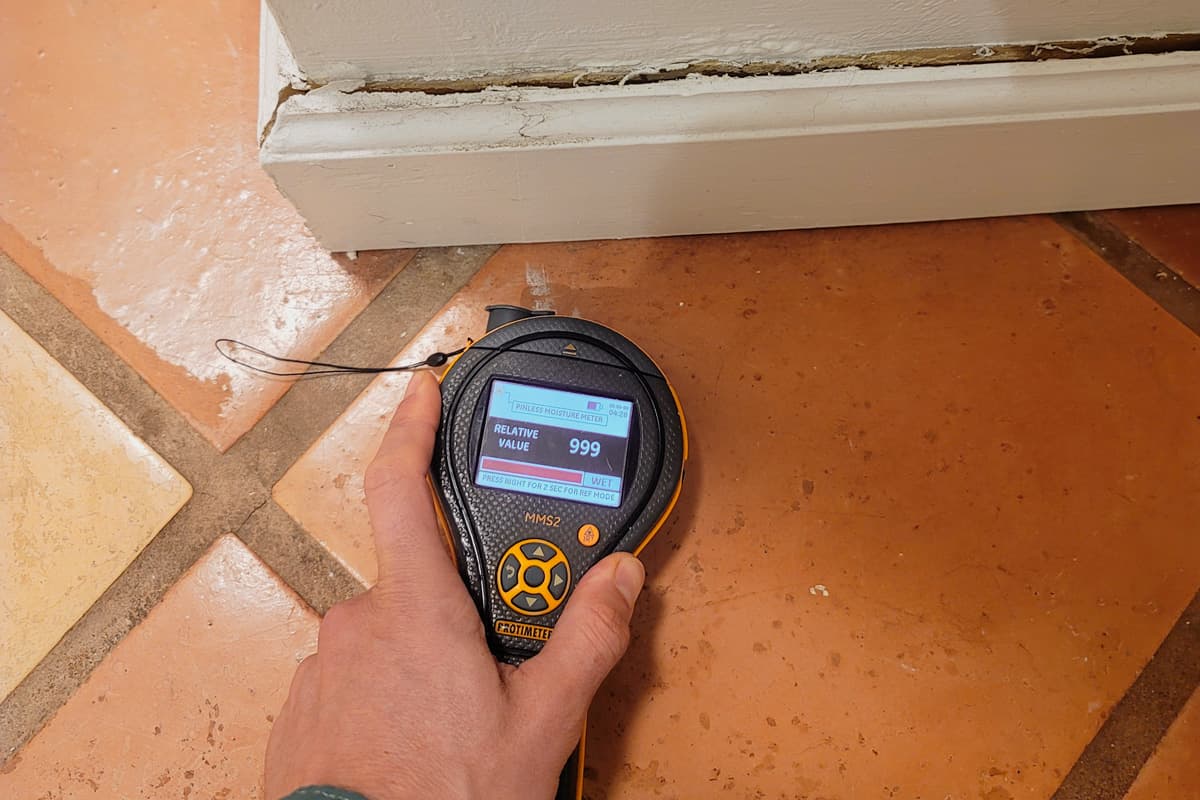
When we assessed the unit we found what the first inspection had missed: elevated moisture levels in the space and building materials that our moisture meter confirmed were wet. We prepared a remediation protocol and were clear with the tenant about what proper remediation would require. Given the extent of what we found, they should expect the work to take at least a week.
The landlord received our protocol and hired a remediation company that completed the job in a single day using a fogging treatment. The tenant was handed a clearance certificate and a mold-free lab result. For a job we had estimated at a minimum of one week, that turnaround did not add up and the tenant called us to reinspect and test for the presence of mold.
We went back in and collected swab samples from materials that should have been removed. The results confirmed what we suspected: mold was still present. Not dormant, not residual. Actively growing between the seams of the wallpaper in the bathroom. The compromised materials had never come out. The moisture source had never been properly addressed. The fog had filled the room and done nothing to the mold growing behind the wallpaper on wet drywall that was never removed.
I wrote a follow-up remediation protocol. The tenant moved out shortly after to protect their son's health. The wallpaper and drywall were eventually removed, at roughly the same cost it would have been from the start. The landlord had paid thousands of dollars for a fog treatment that failed, lost a good tenant, and created a liability exposure that could have been avoided entirely by following the original protocol.
Why So Many Property Owners Say Yes to Fogging
Fogging treatments are an easy sell because the alternative sounds disruptive and expensive. The pitch usually promises:
- Lower cost than full remediation
- Less disruption to your home or business
- No cutting into walls
- Faster turnaround, sometimes as fast as one day
- A clearance certificate at the end
Some companies go further, leaning on claims of patented technology or proprietary delivery systems to suggest their approach is uniquely effective in a way that sets it apart from standard fogging concerns. A patent is a legal protection for a product or process. It is not a remediation standard, and it does not change what the ANSI/IICRC S520 requires.
For a homeowner or business owner already dealing with the stress and cost of a mold problem, all of this sounds like exactly what they want to hear. And the process itself looks impressive. Rooms fill with thick, dense vapor, and it can appear that something powerful and comprehensive is happening.
Visual impact is not proof of successful remediation. And a one-day turnaround on a problem that took weeks or months to develop should be approached with serious skepticism.
What Proper Mold Remediation Actually Requires According to Industry Standards
According to the ANSI/IICRC S520 Standard, the EPA, and established professional practice, effective mold remediation requires:
- Identifying and correcting the moisture source
- Containing affected areas during the work
- Physically removing damaged porous materials when necessary
- Cleaning remaining surfaces properly using appropriate methods
- Drying the structure thoroughly
- Obtaining independent post-remediation verification from a licensed mold assessor
If a company skips the removal step and relies primarily on fogging chemicals, the contaminated materials are often still in place when the job is called complete. The fog dissipates. The mold does not.
Is There Any Situation Where Fogging Works?
There are scenarios where fogging may serve as a reasonable supplemental tool. These are generally spaces that are unoccupied, unconditioned, and not part of the normal living environment, such as attics, crawl spaces, inside certain wall cavities, and garages. In those settings, fogging may help address dormant contamination in areas that are not practical to fully dismantle.
Fogging may also have a legitimate supporting role within a proper remediation project, specifically after damaged and contaminated materials have been physically removed and the affected area is fully open, and before rebuilding begins. In that context, with the source removed and surfaces exposed, an aerosolized antimicrobial treatment may help address residual contamination on remaining surfaces as one step in a larger, properly executed process.
That is a very different scenario from fogging a finished, occupied space and calling it complete. A supporting tool is not a substitute for proper remediation.
What Florida Law Says About Mold Remediation and Who Can Clear the Work
Florida has some of the strictest mold-related licensing laws in the country, and as a property owner here, understanding them could protect you from paying for work that does not meet the legal standard.
Under Florida Statute 468.8419, licensed mold assessors cannot perform remediation on a property they assessed, and licensed remediators cannot assess or clear their own completed work. The same person or company cannot legally perform both the assessment and the remediation on the same property within a 12-month period.
This law exists because the conflict of interest is real and consequential. A company that profits from remediation has a financial incentive to find more mold, inflate the scope, perform a superficial clearance, or represent a fogging treatment as complete remediation when it is not.
Some companies performing fog treatments also issue their own clearance certificates. In Florida, post-remediation clearance must come from an independent licensed mold assessor. A certificate issued by the same company that performed the work does not meet the legal standard and may carry no weight in a future insurance claim or legal proceeding.
Be aware of another common practice in this space: some fogging companies offer free pre and post-treatment testing if you hire them for the job. It sounds like added value. It is not. A mold test performed by the same company that sold you the treatment and stands to benefit from a clean result is not independent testing. It is a conflict of interest. An independent mold assessment costs a few hundred dollars. The fogging treatment costs thousands. The company offering to throw in free testing likely has already done the math.
If you are ever told that the company doing the remediation can also clear their own work, ask whether that clearance is independent, licensed, and compliant with Florida Statute 468.8419. Then verify their license with the Florida Department of Business and Professional Regulation.
Questions to Ask Before Hiring Any Mold Remediation Company
Before you agree to any mold remediation treatment, ask these questions directly:
- Are you actually removing the mold and the damaged materials, or are you only fogging?
- If you are not removing anything, how exactly are you getting to the mold that is growing inside or behind the walls?
- What chemicals does the fogging treatment use, and is it safe to be in the space during and after treatment?
- What caused the mold in the first place, and what are you doing to make sure it does not come back?
- Will the post-treatment testing be performed by an independent licensed mold assessor?
- Who specifically is conducting it and what are their credentials?
- Are you licensed in Florida to perform this type of mold work?
- Is the fogging being used as part of a full remediation plan, or is it the entire plan?
Any company that tells you the mold can be eliminated without removing damaged materials is at best not qualified to help you. The health of everyone living or working in that space depends on making the right call here.
The Bottom Line on Mold Fogging
I have spent over ten years assessing mold in South Florida homes, condos, and commercial properties. Fogging is one of the most aggressively marketed services in this industry right now, and based on everything I have observed in the field, it has not worked as a standalone solution when active mold contamination is present in wet or damaged building materials.
There may be a limited supplemental role for fogging in specific scenarios, as outlined above. But for real mold problems involving active growth, moisture damage, and compromised materials, there is no substitute for proper remediation. The moisture source must be found and corrected. Damaged materials must be removed. The structure must be dried. And the results must be verified by an independent licensed assessor who has no financial stake in the outcome.
The decision you make about how to address a mold problem in your home or building is a health decision. Treat it like one.
If you have a remediation contractor suggesting fogging as the primary solution, consider hiring Clean Air Miami to assess the situation and create a mold remediation protocol that follows industry standards, guidelines, and comes with a decade of specialized experience. We conduct independent licensed mold assessments, we do not perform remediation, and that separation is intentional. In Florida, it is also the law.
Call us at 305-814-8175 or schedule a consultation here.
Frequently Asked Questions
Does mold fogging work?
It may have a limited supplemental role in certain unoccupied or unconditioned spaces such as attics and crawl spaces, but based on my field observations it has not reliably resolved active mold contamination when wet or damaged building materials are involved. The ANSI/IICRC S520 Standard is clear that source removal is the fundamental principle of proper mold remediation. Fogging does not remove compromised materials and does not correct the moisture source that caused the problem.
Is fogging safe?
It depends on the chemicals used and the occupants of the space. Many fogging treatments use aerosolized antimicrobials such as peracetic acid (PAA) or hydrogen peroxide-based compounds. These can cause VOCs to off-gas into the indoor environment during and after treatment. For chemically sensitive individuals, people with asthma, multiple chemical sensitivity, respiratory conditions, or compromised immune systems, the off-gassing from fogging chemicals is a serious health consideration that should not be overlooked. Always ask the company what chemicals they are using, request the safety data sheets, and consult a physician if anyone in the household has known sensitivities before agreeing to any fogging treatment.
Who is most at risk from unresolved mold contamination?
The CDC and EPA both recognize that certain groups face greater health risks from mold exposure: children, the elderly, pregnant women, individuals with asthma or allergies, and anyone with a compromised immune system or chemical sensitivity. For these groups, a fogging treatment that fails post-remediation testing is not a minor inconvenience. It is a health hazard that warrants proper professional remediation, physical removal of contaminated materials, and independent verification from a licensed assessor.
Is there a safe level of toxic mold in an occupied space?
There are no current federal numerical limits for mold in indoor air, but within the professional mold assessment community there is a well-established zero-tolerance standard for specific toxic species including Stachybotrys, Chaetomium, Memnoniella, Fusarium, and Trichoderma. A single spore from any of these species recovered in post-remediation air sampling is widely considered a failed remediation result. Killing mold with a fogging chemical does not eliminate this risk, as dead spores can still cause allergic and toxigenic responses in sensitive individuals.
Can mold remediation be done without removing building materials?
The ANSI/IICRC S520 Standard defines source removal as the fundamental principle of mold remediation. If any porous building material including drywall, insulation, wallpaper, or wood is wet, mold-damaged, or supporting active growth, removal is generally necessary. There is no fogging treatment that reverses water damage or eliminates mold embedded in compromised materials regardless of how it is marketed.
Can a mold remediation company clear its own work in Florida?
Under Florida Statute 468.8419, a licensed remediator cannot assess or clear the same property they remediated within a 12-month period. Post-remediation clearance must come from an independent licensed mold assessor. A certificate issued by the same company that performed the work does not meet the legal standard in Florida and may carry no weight in a future insurance claim or legal proceeding.
What does proper mold remediation require?
According to the ANSI/IICRC S520 Standard and EPA guidance, effective remediation requires identifying and correcting the moisture source, physically removing contaminated materials when necessary, cleaning and drying the structure, and obtaining independent post-remediation verification from a licensed assessor. The specific scope depends on the extent and location of the contamination.